PBS KIDS Internship
Designed and tested game mechanics, UI content, and background & character design assets for a second-language-learning product.
BACKGROUND · UI/UX DESIGN — 2025
01
PROJECT OVERVIEW
Folklore Journey
A collaborative PBS KIDS internship project exploring how storytelling, sequencing, and spoken language help children (ages 6–8) engage with bilingual vocabulary through global folklore.
ROLE
UI/UX & Background/Character Designer
YEAR
2025
GOAL
Following PBS KIDS' content guidelines to build comprehension and social language skills inside meaningful story moments.
02
Concept Framing
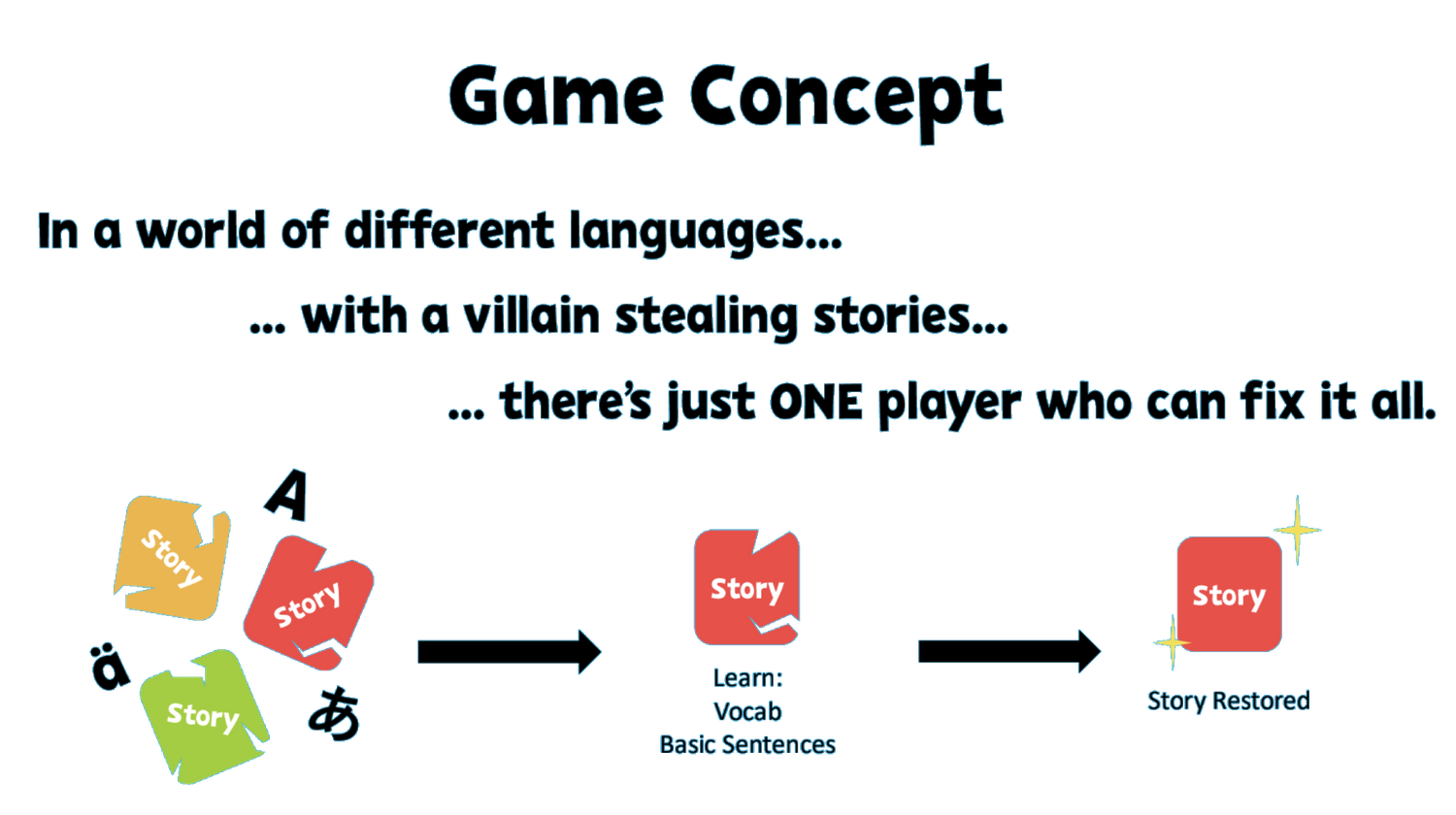
We looked at children's story-based games and bilingual learning tools, then reimagined the experience around problem-solving and exploration rather than drills.
Storyteller lent its panel-based visual sequencing to our sentence-building mechanic; Miitopia lent its character-driven world map, giving the player a sense of journey between folktales.
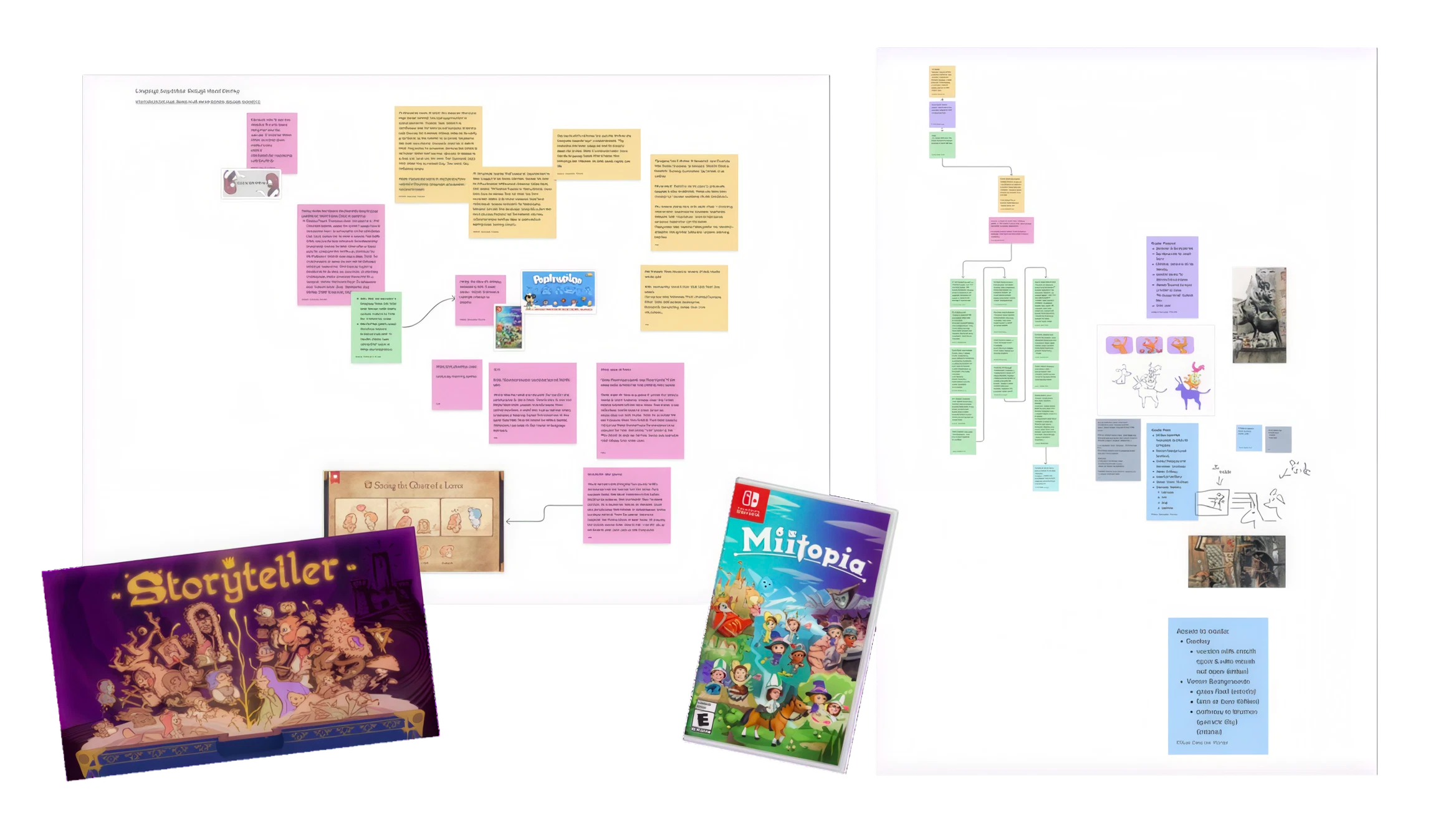
We chose the Bremen Town Musicians as our pilot folktale — a small, clear cast of four animals with naturally distinct silhouettes, with enough global recognition as a fairy tale to garner interest from new users.
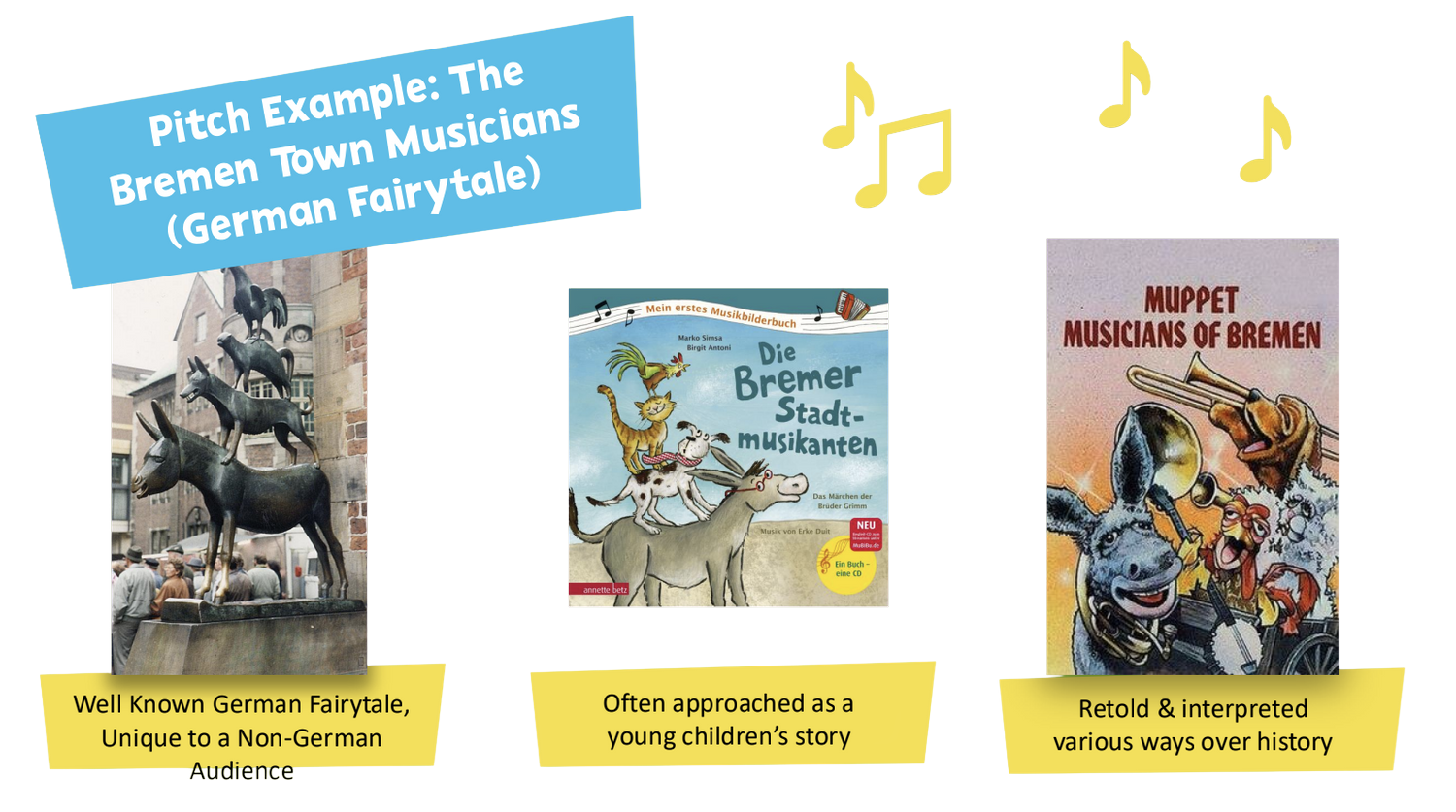
FIG. 01 — CONCEPT RESEARCH & REFERENCES
03
Character Design
Every character started from silhouette. The goal was a shape a six-year-old could identify at a glance.
Each animal then got one saturated, consistent color (red rooster, indigo cat, orange dog, sage donkey), so color itself becomes a memory anchor tied to each word. Rough sketches explored proportion and personality before I flattened and exaggerated the shapes, stripping out sketch texture so each character reads cleanly.
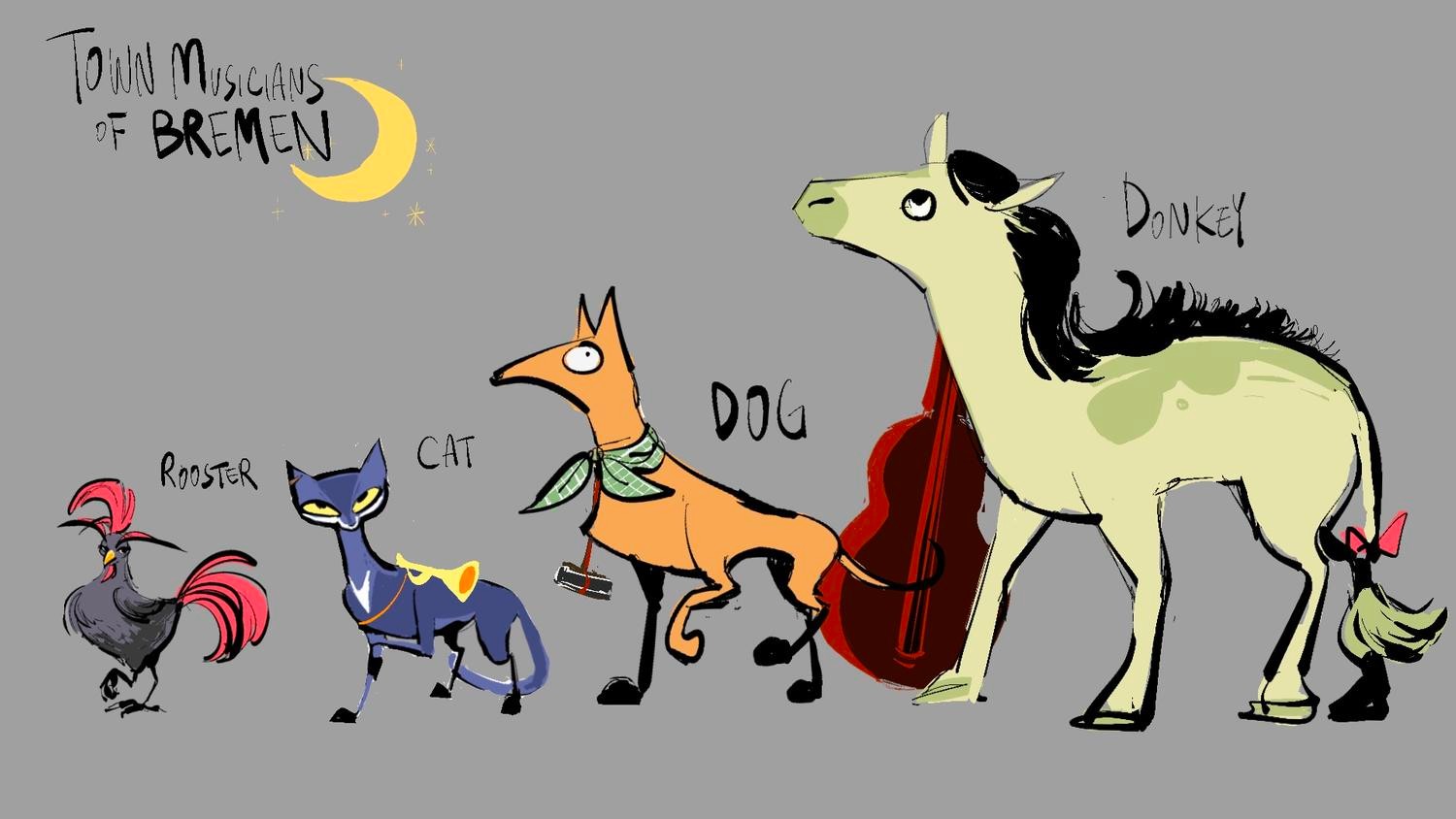
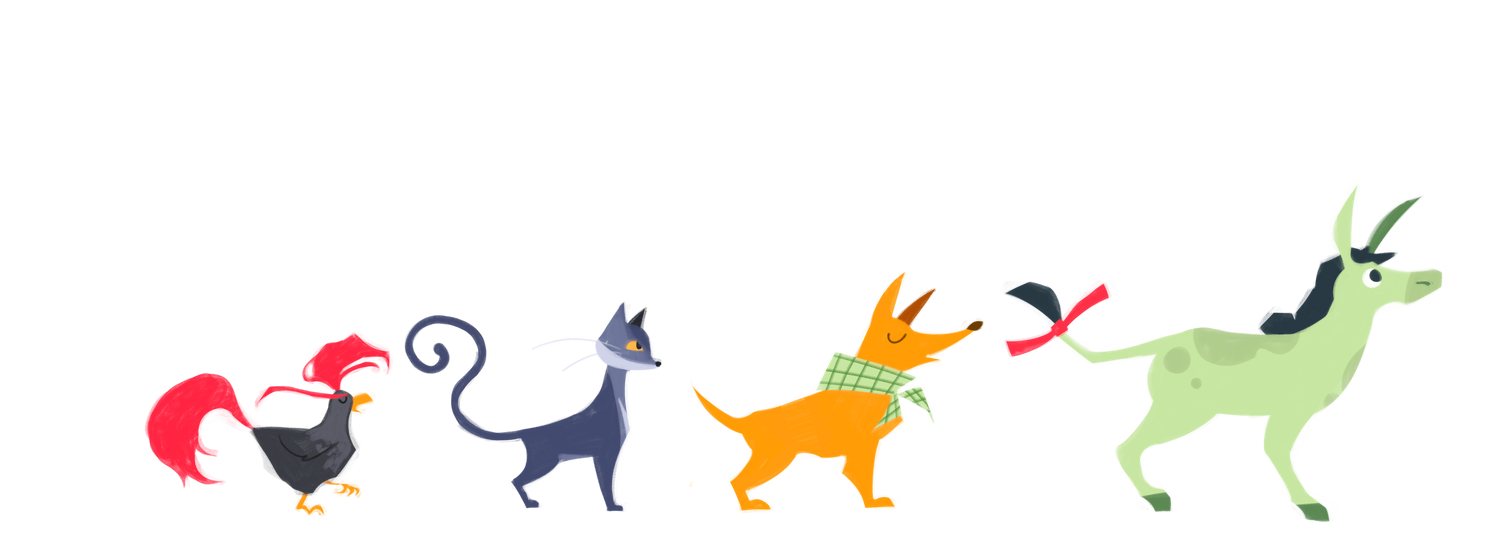
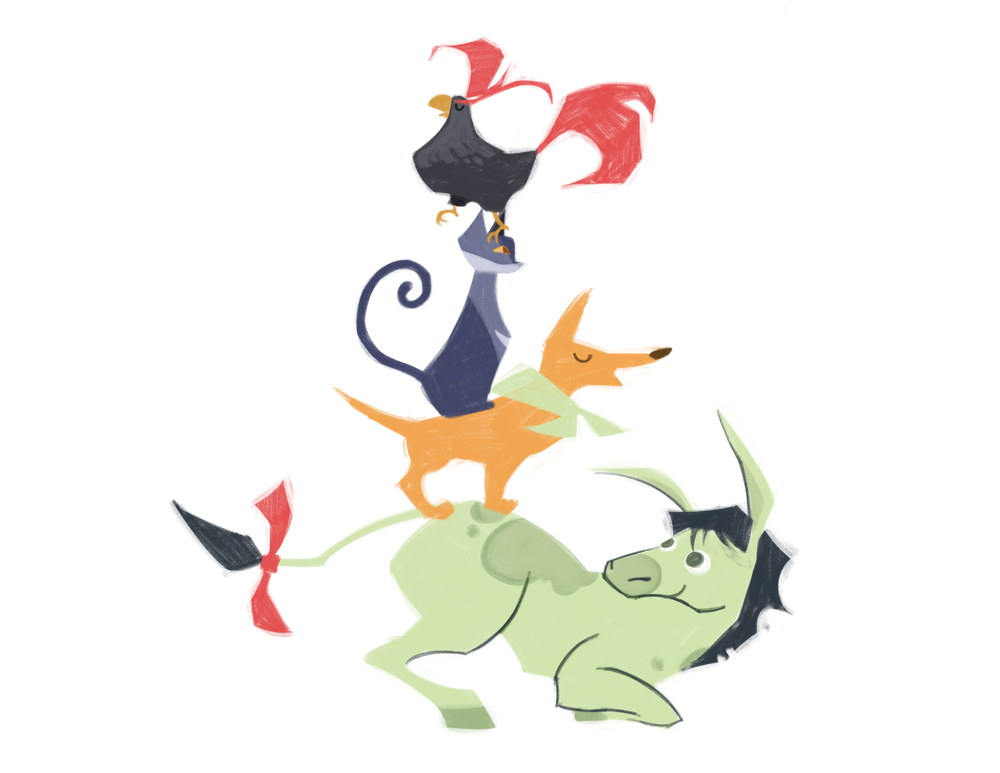
FIG. 02 — CHARACTER STUDIES & FINAL CAST
04
Background Asset Design
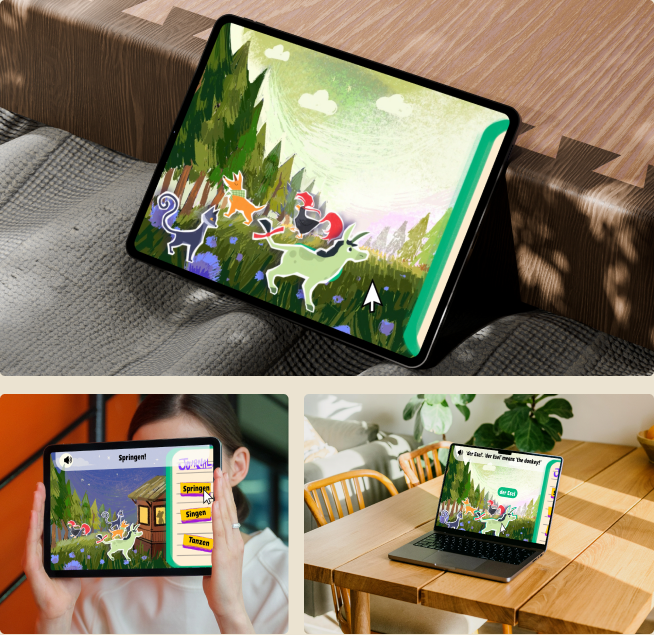
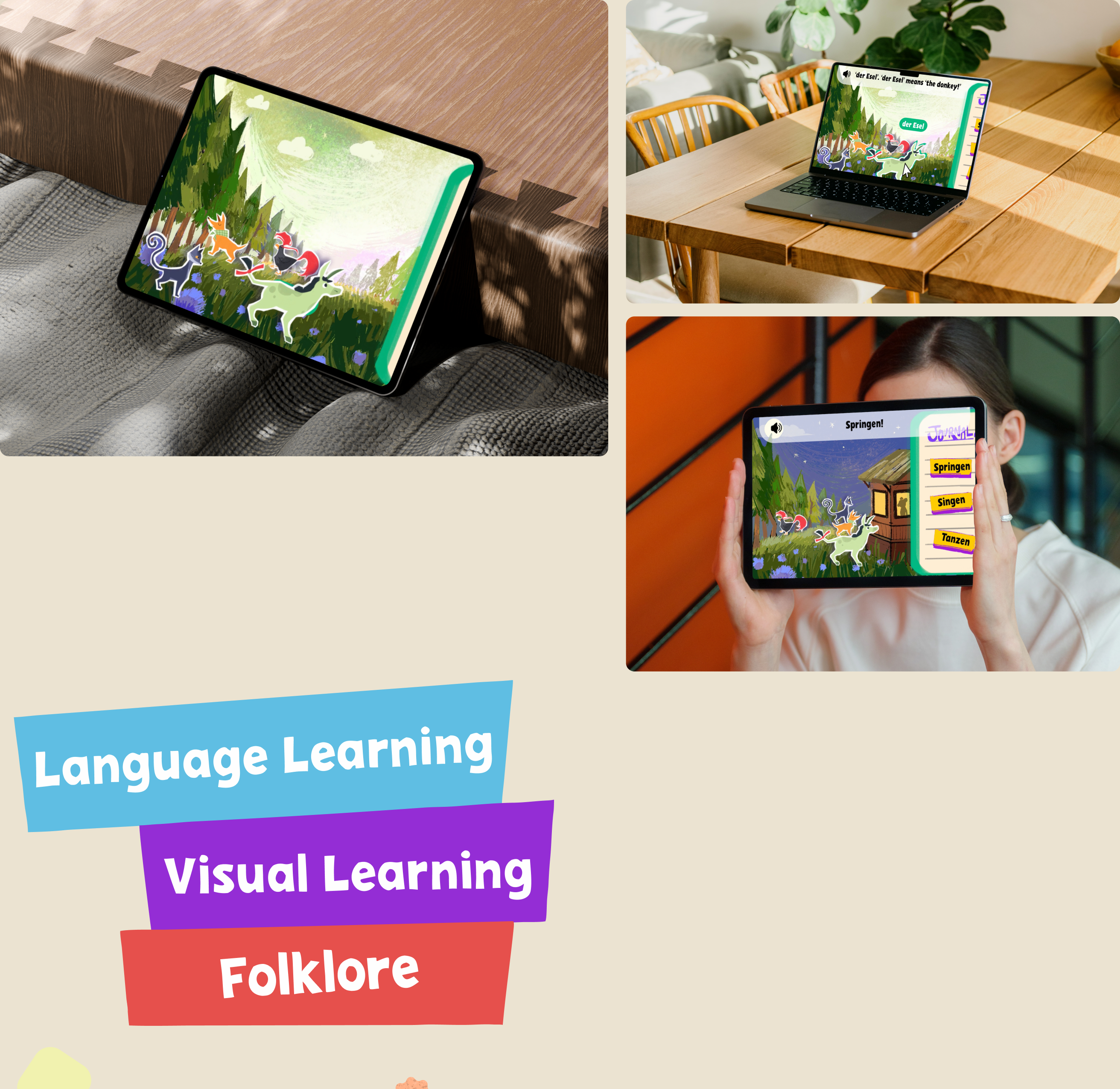
Backgrounds use a painterly, grain-textured illustration style borrowed from storybook art, giving the screens warmth instead of a slick app feel — sunlit forest greens for exploration, deep night blues for tension.
The word bank posed a different problem: how do you make a vocabulary list feel like part of the story instead of a quiz? I redesigned it as a "journal,” a tabbed notebook the player carries. Inside, new verbs like "Springen," "Singen," and "Tanzen" appear as torn-paper specimen labels to be collected.
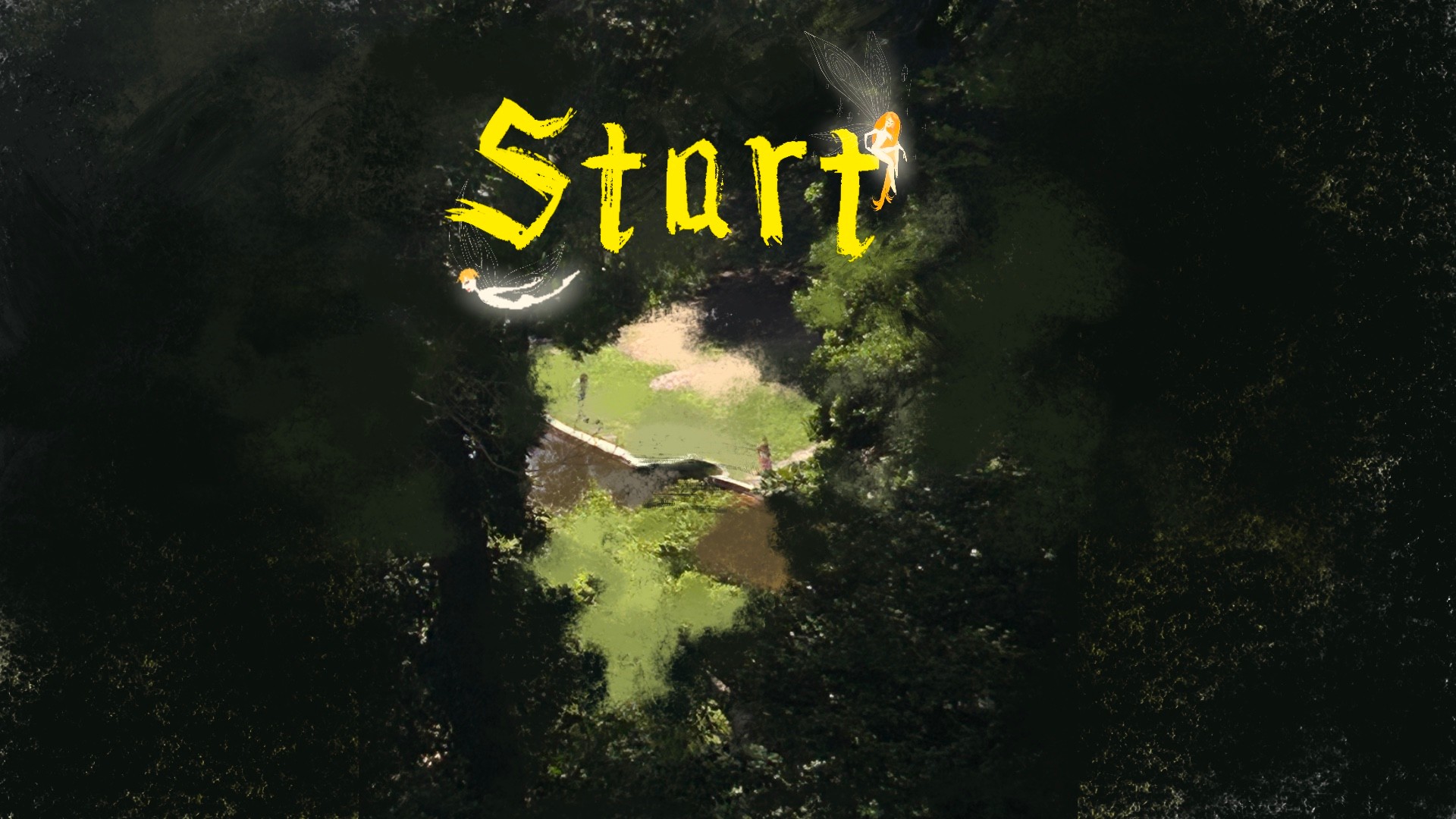
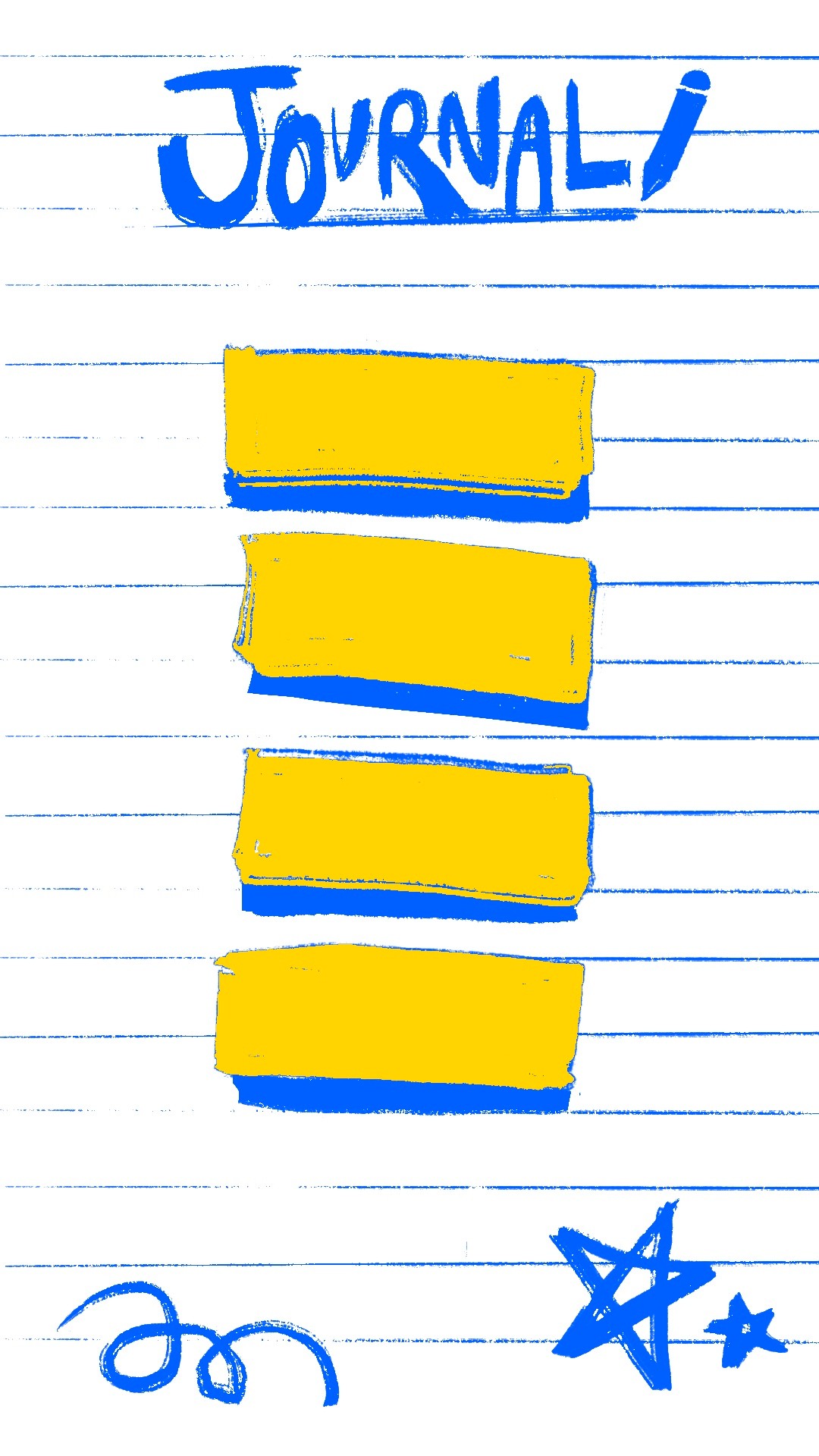
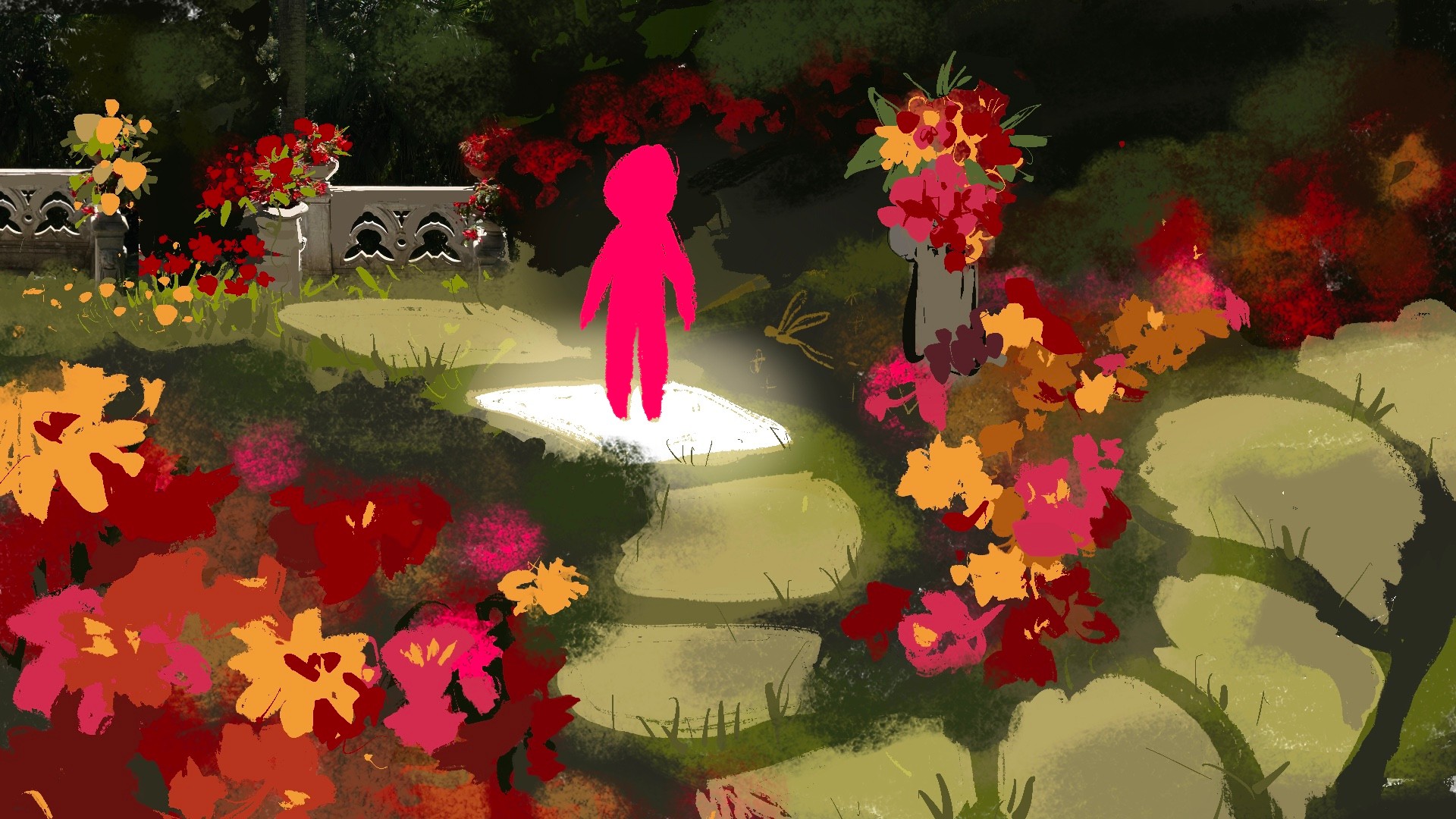
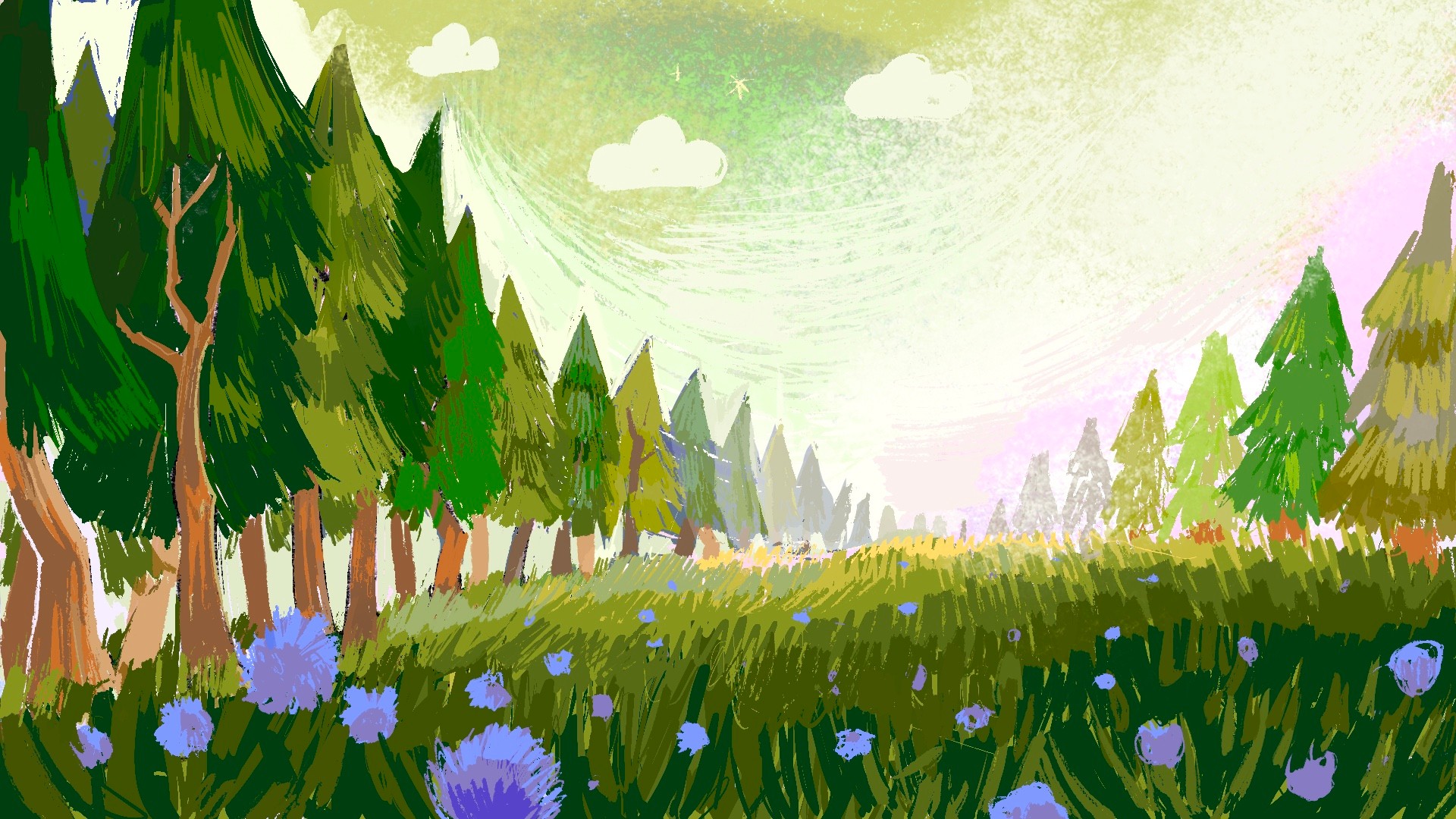
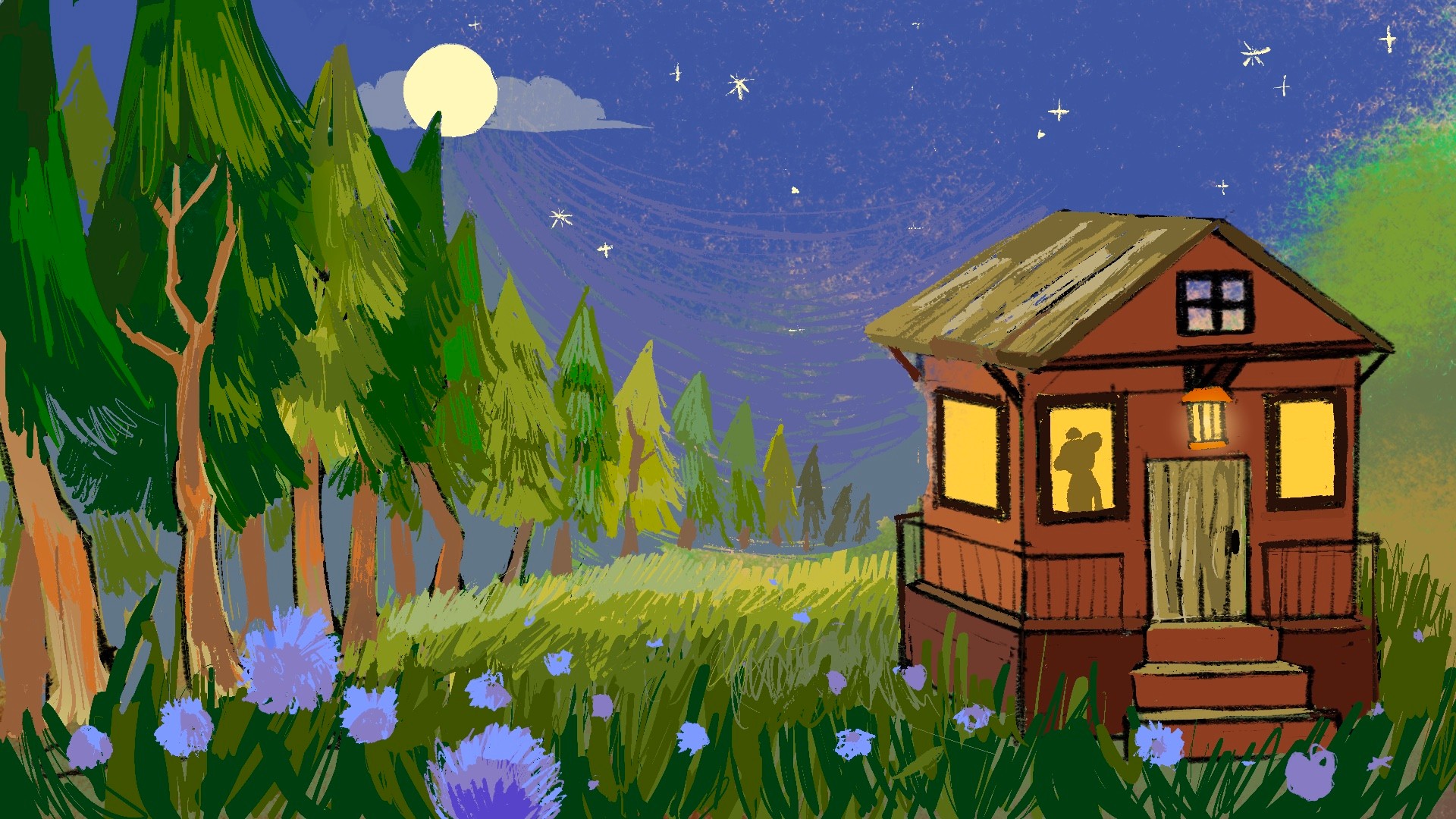
FIG. 03 — BACKGROUND ART & JOURNAL SYSTEM
05
Iteration
The low-fidelity prototype tested the core drag-and-drop verb mechanic with a single character before any finished visual asset was brought into play.
The UX flow of “Play → Choose → Speak → Sequence → Restore” was kept in mind during the development of the game.
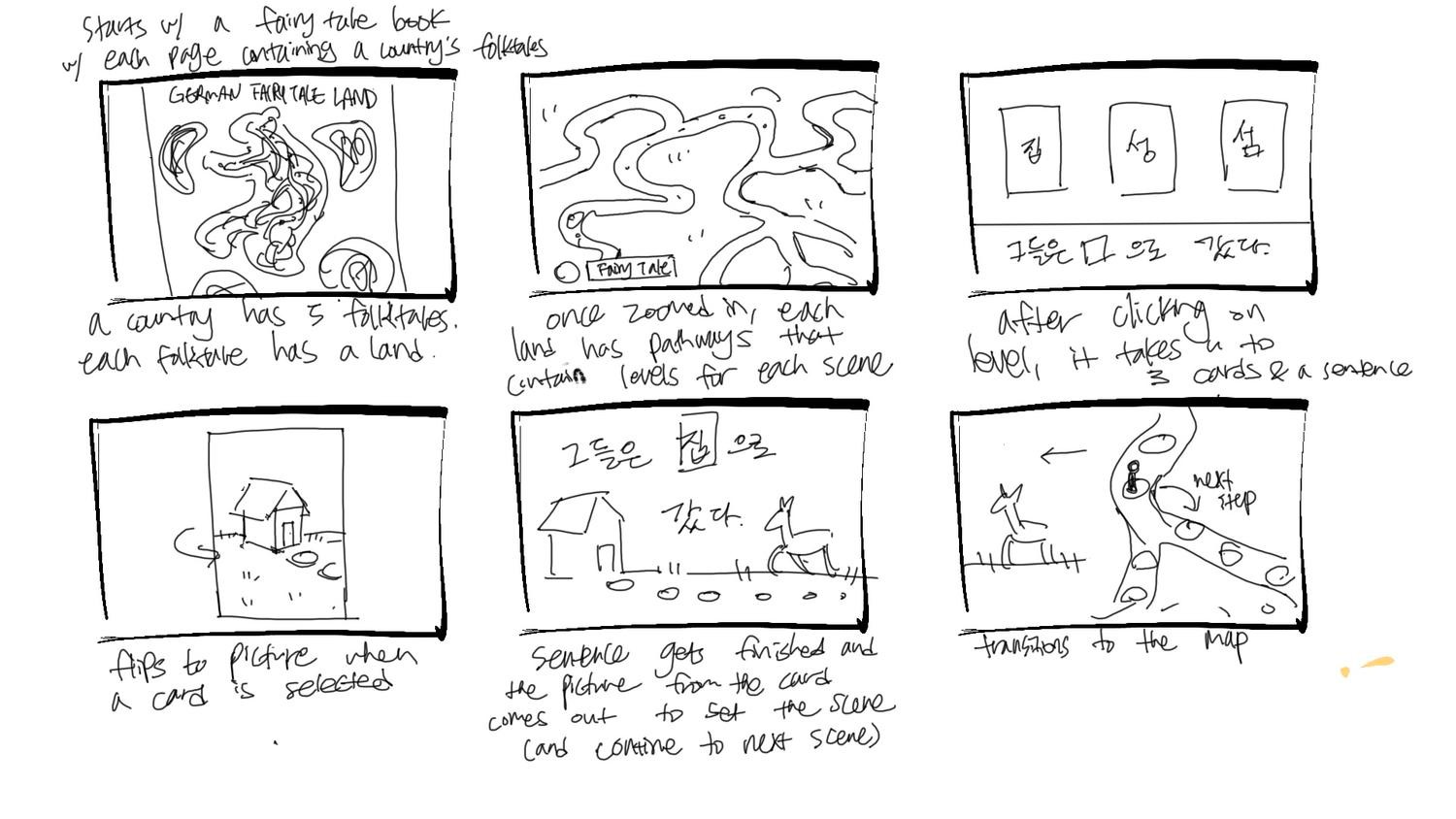
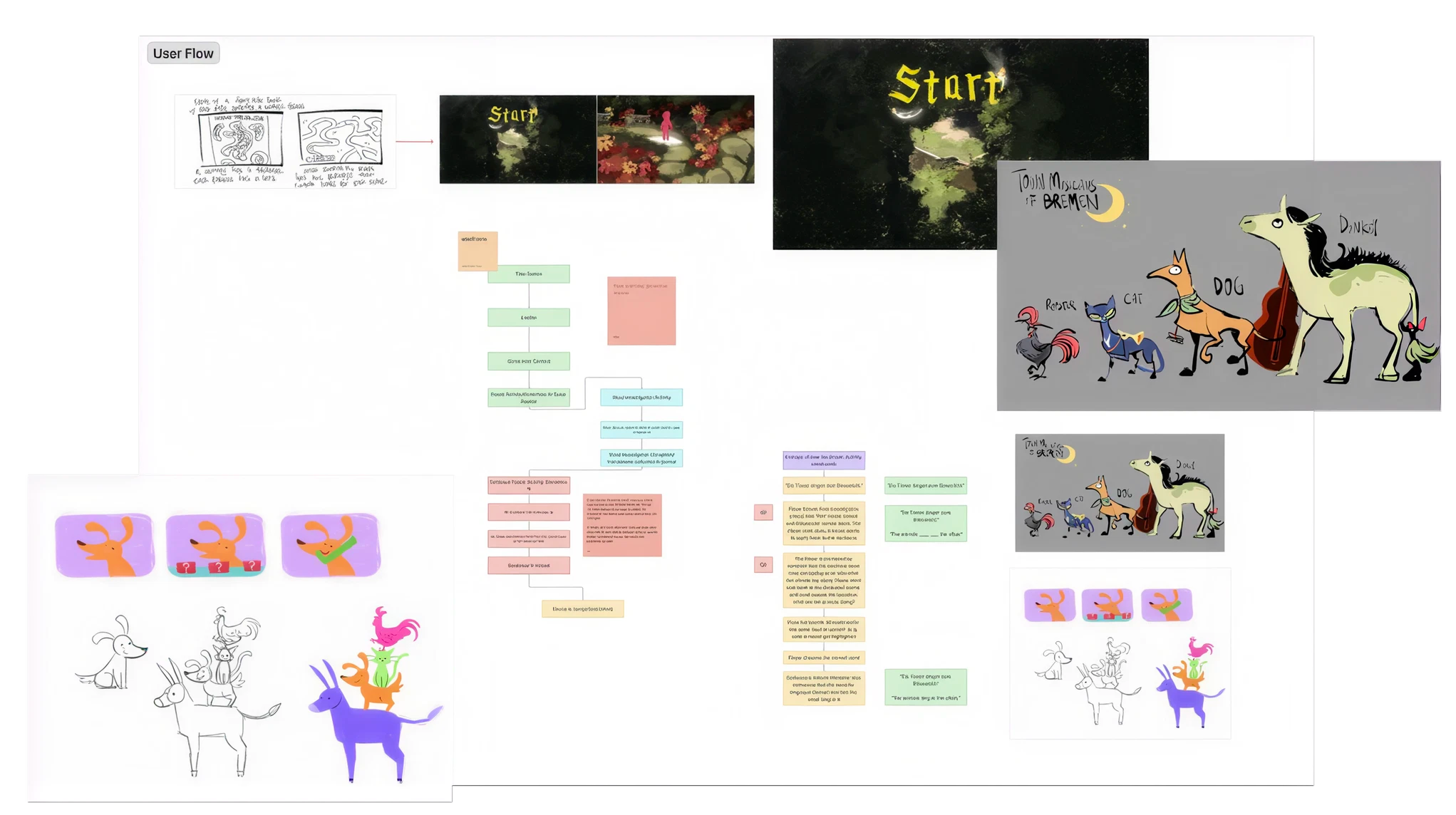
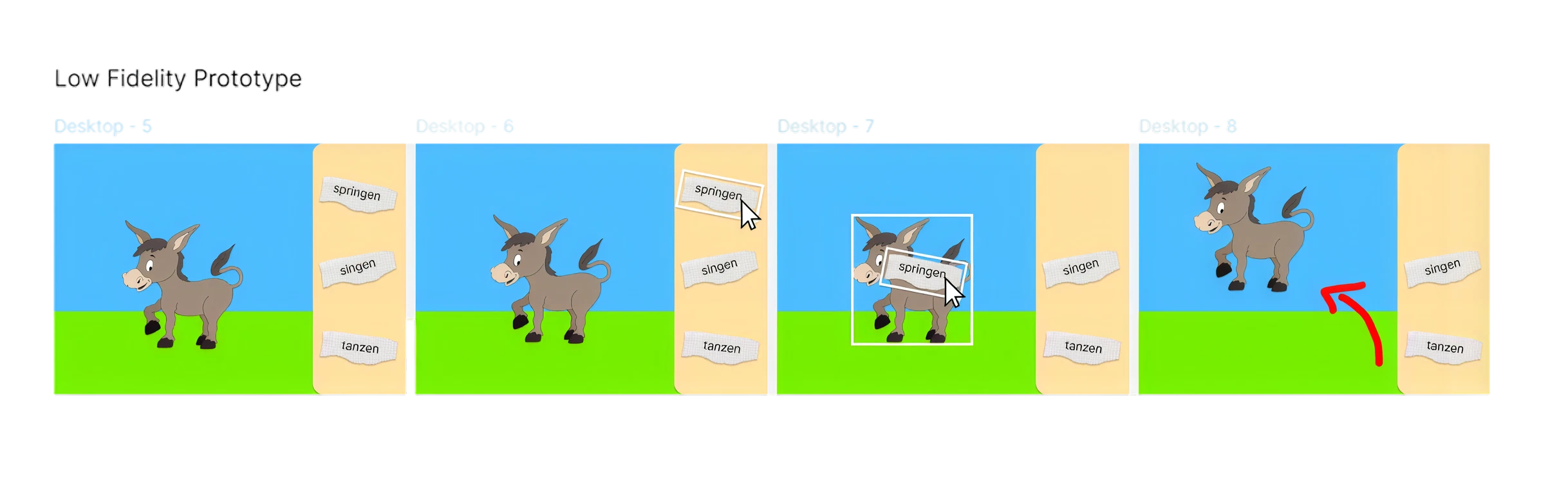
FIG. 04 — LOW-FI ITERATION
06
Final Prototype
The final prototype includes full backgrounds, refined character linework, and the journal and word-card system working together inside real story moments, with sound and motion cues reinforcing each word's meaning.
FIG. 05 — FINAL PROTOTYPE WALKTHROUGH
07
Reflection
Working on this project reminded me how powerful language learning can be when it happens inside a story rather than through drills. When kids use words to move characters forward and shape what happens next, the experience feels alive. Collaborating with the PBS KIDS designers and game developers and learning from how they think about how children play and learn helped turn early sketches into something more intentional and kid-centered.
Next, I'd like to bring these prototypes into playtesting sessions with 6–8-year-olds, to see how they explore, what they notice, and how they retell the story in their own words.
PBS KIDS — graphic design — 05/06


PBS KIDS Internship
Designed and tested game mechanics, UI content, and background & character design assets for a second-language-learning product.
BACKGROUND · UI/UX DESIGN — 2025
01
PROJECT OVERVIEW
Folklore Journey
A collaborative PBS KIDS internship project exploring how storytelling, sequencing, and spoken language help children (ages 6–8) engage with bilingual vocabulary through global folklore.
ROLE
UI/UX & Background/Character Designer
YEAR
2025
GOAL
Following PBS KIDS' content guidelines to build comprehension and social language skills inside meaningful story moments.
02
Concept Framing
We looked at children's story-based games and bilingual learning tools, then reimagined the experience around problem-solving and exploration rather than drills. Storyteller lent its panel-based visual sequencing to our sentence-building mechanic; Miitopia lent its character-driven world map, giving the player a sense of journey between folktales.
We chose the Bremen Town Musicians as our pilot folktale — a small, clear cast of four animals with naturally distinct silhouettes, with enough global recognition as a fairy tale to garner interest from new users.
FIG. 01 — CONCEPT RESEARCH & REFERENCES
03
Character Design
Every character started from silhouette. The goal was a shape a six-year-old could identify at a glance.
Each animal then got one saturated, consistent color (red rooster, indigo cat, orange dog, sage donkey), so color itself becomes a memory anchor tied to each word. Rough sketches explored proportion and personality before I flattened and exaggerated the shapes, stripping out sketch texture so each character reads cleanly.
FIG. 02 — CHARACTER STUDIES & FINAL CAST
04
Backgrounds & the Journal
Backgrounds use a painterly, grain-textured illustration style borrowed from storybook art, giving the screens warmth instead of a slick app feel — sunlit forest greens for exploration, deep night blues for tension.
The word bank posed a different problem: how do you make a vocabulary list feel like part of the story instead of a quiz? I redesigned it as a "journal,” a tabbed notebook the player carries. Inside, new verbs like "Springen," "Singen," and "Tanzen" appear as torn-paper specimen labels to be collected.


FIG. 03 — BACKGROUND ART & JOURNAL SYSTEM
05
Iteration
The low-fidelity prototype tested the core drag-and-drop verb mechanic with a single character before any finished visual asset was brought into play.
The UX flow of “Play → Choose → Speak → Sequence → Restore” was kept in mind during the development of the game.
FIG. 04 — LOW-FI ITERATION
06
Final Prototype Walkthrough
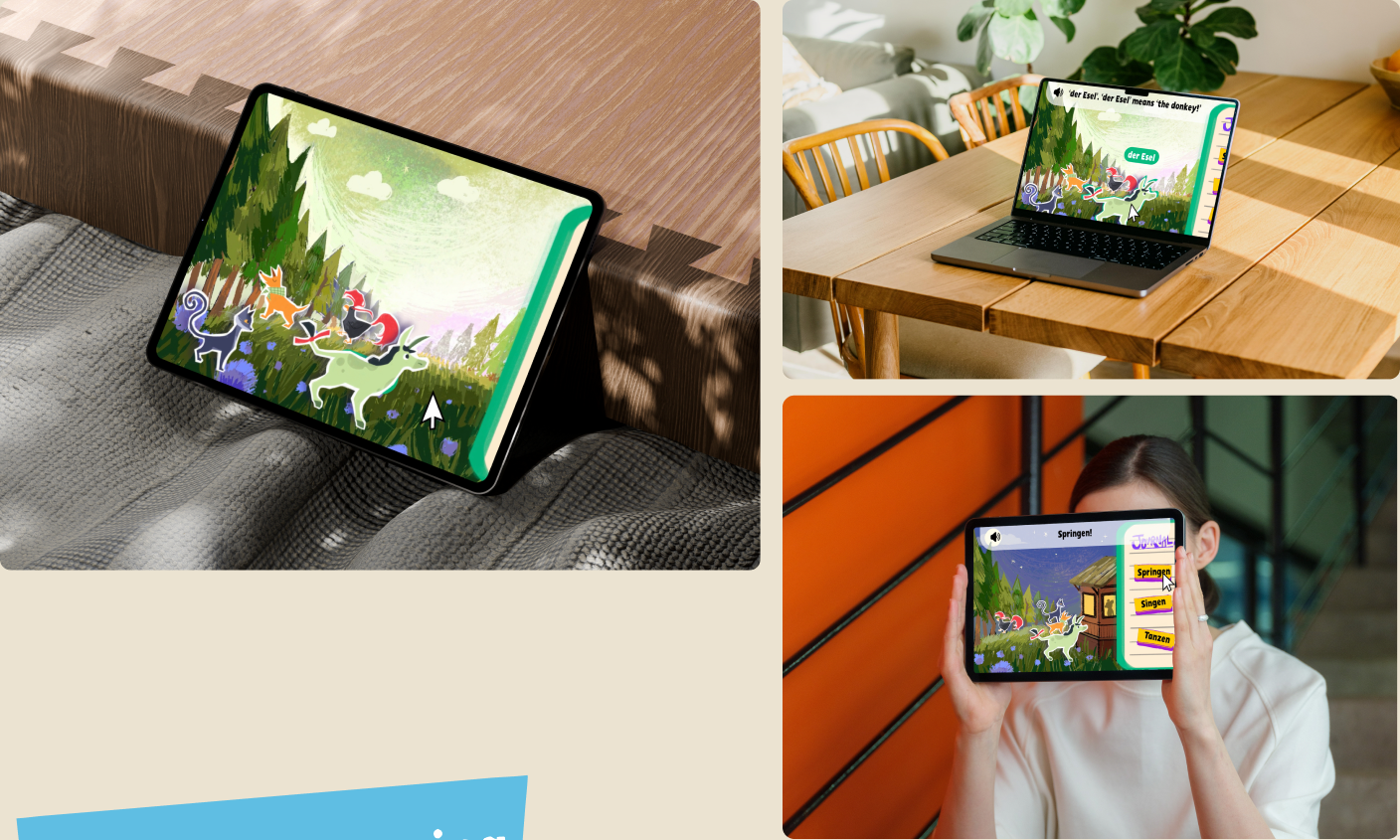
The final prototype includes full backgrounds, refined character linework, and the journal and word-card system working together inside real story moments, with sound and motion cues reinforcing each word's meaning.
FIG. 05 — FINAL PROTOTYPE WALKTHROUGH
07
Reflection
Working on this project reminded me how powerful language learning can be when it happens inside a story rather than through drills. When kids use words to move characters forward and shape what happens next, the experience feels alive. Collaborating with the PBS KIDS designers and game developers and learning from how they think about how children play and learn helped turn early sketches into something more intentional and kid-centered.
Next, I'd like to bring these prototypes into playtesting sessions with 6–8-year-olds, to see how they explore, what they notice, and how they retell the story in their own words.
PBS KIDS — graphic design — 05/06







PBS KIDS Internship
Designed and tested game mechanics, UI content, and background & character design assets for a second-language-learning product.
BACKGROUND · UI/UX DESIGN — 2025
01
PROJECT OVERVIEW
Folklore Journey
A collaborative PBS KIDS internship project exploring how storytelling, sequencing, and spoken language help children (ages 6–8) engage with bilingual vocabulary through global folklore. My focus was the visual side: background illustration, character design, and the in-world "journal" and word-card system that turns vocabulary into something kids discover and collect rather than memorize.
ROLE
UI/UX & Background/Character Designer
YEAR
2025
GOAL
Following PBS KIDS' content guidelines — connect images, words, and audio while building comprehension and social language skills inside meaningful story moments.
02
Concept Framing
We looked at children's story-based games and bilingual learning tools, then reimagined the experience around problem-solving and exploration rather than drills. Storyteller lent its panel-based visual sequencing to our sentence-building mechanic; Miitopia lent its character-driven world map, giving the player a sense of journey between folktales.
We chose the Bremen Town Musicians as our pilot folktale — a small, clear cast of four animals with naturally distinct silhouettes, with enough global recognition as a fairy tale to garner interest from new users.
FIG. 01 — CONCEPT RESEARCH & REFERENCES
03
Character Design
Every character started from silhouette. The goal was a shape a six-year-old could identify at a glance. Each animal then got one saturated, consistent color (red rooster, indigo cat, orange dog, sage donkey), so color itself becomes a memory anchor tied to each word. Rough sketches explored proportion and personality before I flattened and exaggerated the shapes, stripping out sketch texture so each character reads cleanly.
FIG. 02 — CHARACTER STUDIES & FINAL CAST
04
Backgrounds & the Journal
Backgrounds use a painterly, grain-textured illustration style borrowed from storybook art, giving the screens warmth instead of a slick app feel — sunlit forest greens for exploration, deep night blues for tension.
The word bank posed a different problem: how do you make a vocabulary list feel like part of the story instead of a quiz? I redesigned it as a "journal,” a tabbed notebook the player carries. Inside, new verbs like "Springen," "Singen," and "Tanzen" appear as torn-paper specimen labels to be collected.


FIG. 03 — BACKGROUND ART & JOURNAL SYSTEM
05
Iteration
The low-fidelity prototype tested the core drag-and-drop verb mechanic with a single character before any finished visual asset was brought into play.
The UX flow of “Play → Choose → Speak → Sequence → Restore” was kept in mind during the development of the game.
FIG. 04 — LOW-FI ITERATION
06
Final Prototype Walkthrough
The final prototype includes full backgrounds, refined character linework, and the journal and word-card system working together inside real story moments, with sound and motion cues reinforcing each word's meaning.


ADD VIDEO WALKTHROUGH
(Unmute for Sound Effects)
FIG. 05 — FINAL PROTOTYPE WALKTHROUGH
07
Reflection
Working on this project reminded me how powerful language learning can be when it happens inside a story rather than through drills. When kids use words to move characters forward and shape what happens next, the experience feels alive. Collaborating with the PBS KIDS designers and game developers and learning from how they think about how children play and learn helped turn early sketches into something more intentional and kid-centered.
Next, I'd like to bring these prototypes into playtesting sessions with 6–8-year-olds, to see how they explore, what they notice, and how they retell the story in their own words.
PBS KIDS — graphic design — 05/06